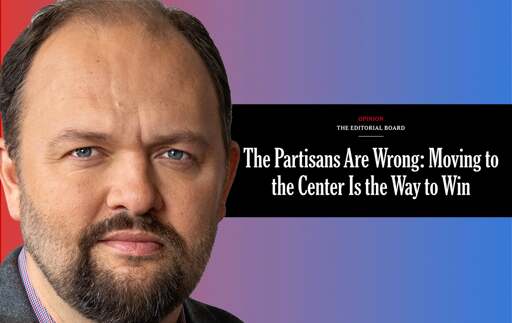
The New York Times editorial board is wrong. Principled progressive politics on the Bernie Sanders model is still the path forward.
There is a very simple political narrative, repeated ad nauseum, that goes something like this:
The average American does not like “extreme” politicians of the right or left. As the right becomes more extreme, Democrats should “occupy the center lane,” offering “moderate” solutions with broad appeal. If they become too “extreme,” they will alienate the average voter. They should therefore retreat from excessively “progressive” positions, proving themselves to be the “reasonable” alternative to the right. When Democrats lose, it is because they have “gone too far left,” and they must return to the sensible, careful, reasonable center in order to win.
(I use quotes because I think all of these terms need to be questioned rather than accepted at face value.)
This is, roughly, the thesis of the New York Times editorial board’s recent article “The Partisans Are Wrong: Moving to the Center Is the Way to Win,” which makes a forceful argument that Democrats must abandon progressivism for the sake of stopping Donald Trump. Not only is centrism pragmatic, the Times argues, but the need to stop the right is so urgent that Democrats have no choice but to embrace centrism. There is simply no alternative.
The case the Times editorial board makes for the political efficacy of centrism is unpersuasive, which I will get to. But before I do, let me first object to the terms of the debate. The question the Times answers is, effectively: are Democrats more likely to win elections on centrist or progressive platforms? The unstated premise of the piece is that Democrats should do whatever makes them most likely to win elections, and so if the answer to that question is “they are more likely to win on centrist platforms,” that means they should run on centrist platforms. Whenever we consider a political position, they want us to ask ourselves “how does it poll?”, and not “is it right?” or “is it true?”
This may sound so obviously correct that it does not require defending—what, you don’t want to win elections?—but that is not so. Imagine we are in the year 1960, and a hotly debated political question is whether it should be legal for companies to discriminate on the basis of race. Now imagine we pose the question: “Are Democrats more likely to win elections if they endorse full racial equality or if they hedge on it?” We might find out that Democrats are more likely to win elections if they decline to endorse full equality, because much of the American public is still outright racist.
But that would not lead us to the automatic conclusion that Democrats should not endorse racial equality. In fact, such a conclusion would be highly morally questionable, because it would suggest that vital moral principles are not worth defending if they make it even slightly harder to get elected. To use a more extreme hypothetical, what if the data showed us that candidates who engaged in explicitly racist messaging were more likely to win, because demagoguery works? Would the Times recommend going full racist in order to win? (To be honest, they might.)
The Times argues that the data show “moderate candidates fare a few percentage points better, on average, than otherwise similar candidates,” and because “a few” points can be the difference between winning and losing, this is a sound argument for consistently remaining centrist. But that is so only if you don’t care much about the stances you are abandoning by embracing centrism. This is easy for the Times, because they hold centrist values, and do not appear to feel any inner conflict about abandoning, say, immigrants and trans people for the sake of winning elections. But to those of us who think immigrant rights and trans rights are important in the same way as Black civil rights, showing that defending the marginalized might cost “a few” percentage points in swing districts does not provide proof that we should ditch the issue. Instead, accepting the empirical finding would lead us to a different conclusion: we simply have to work harder to win elections, because the path of justice is more challenging than the path of expedience.
Americans need to realize the centre is actually 2 miles left of their “extreme left wing”.
That’s what I’m saying. Free healthcare, affordable housing, get prices under control. These are the things almost everyone wants
This is where I think praxis gets in the way. You have to meet people where they are, and they’re not ready for a new ideology or to learn a new analytical lens to view the world
People are ready for change though. They’ve had enough of corruption and profiteering of their suffering. They overwhelmingly want what leftists and progressives want, they need to be shown that progressive candidates will actually deliver when elected
Centrists just saying shit. They’re never going to admit that they are wrong. They need to be beaten and ignored.
Video essay version here: https://www.youtube.com/watch?v=uB2a1EAAl0Q
Nathan, you goofball.
Only 28% of voters are Democrats, and only about 10% of independents (44% of voters) are to the left of Democrats.
I’m not a mathematics professor, but I believe that means that 62% of voters aren’t as left as Democrats. They vote too, you see. You’re supposed to represent everybody, that’s your job.
Independents are 44% of voters, and about 30% of those are centrists. Ignore them at your peril.
There are many things left and center agree on (like term limits, minimum wage increase, no war, pre-Reagan taxes on the wealthy, universal healthcare, age limits on reps).
Serve your electorate or lose.
Partisans lie. Math does not. Do the math.
https://www.pewresearch.org/politics/fact-sheet/party-affiliation-fact-sheet-npors/
Where are you getting those numbers in your link?