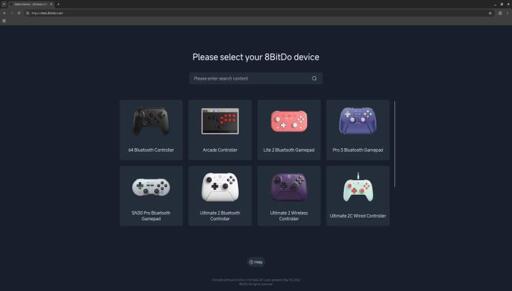
8BitDo say Ultimate Software Online is their attempt to make things easier for Linux gamers, no need to download a standalone firmware updater app now.
All of these wed based uber-projects are built on Chrome. This is bad. This gives more control to google and strengthens their strangle hold over web technologies.
As long as it’s doable from userspace the OS doesn’t know what’s a browser or what is being controlled with external code. Blame the concept of ambient authority
their competitor has an advantage and real leverage, I’d say that’s enough reason in economics? I get why it isn’t implemented, but all that means is that chromium has the high ground when it comes to this.
This is exactly why economics, or any discipline, should not be permitted to dictate the function or structure of a system in a domain outside of its area of expertise.
Maybe some of the other browsers should implement the tech needed to do this kind of thing then? Cause as far as I know, Chrome is the only browser that can give a websites access to USB.
Adding security, compatability, and vendor lock-in issues in exchange for convenience is not a good thing. Remember ActiveX and Silverlight? They forced users into uning IE. I am still finding industrial applications whos only config page is some ancient, IE only, nightmare.
In this case the spec is published, so it wouldn’t be a lock-in or compatibility issue if the other vendors didn’t lock themselves out.
Security, I get, but when I’ve used it to flash esp32s before the user agent pops up a box asking me which device I want to give access to before the website sees anything, so it’s not transparent and it doesn’t give it access to everything on my system.
I use Firefox all the time, but keep a Chromium on my system basically for stuff like this occasionally, and also web calls because Firefox’s implementation of the audio API doesn’t let me change microphones in the webapp, it just exposes one mic, and I’ve had issues with that before, so I join all calls in Chromium.


All of these wed based uber-projects are built on Chrome. This is bad. This gives more control to google and strengthens their strangle hold over web technologies.
It’s also bad because why the fuck should a web browser have that much access to the hardware to begin with?!
Also why the fuck is the OS giving the web browser the option of giving it that access to the hardware?
As long as it’s doable from userspace the OS doesn’t know what’s a browser or what is being controlled with external code. Blame the concept of ambient authority
Cause WebUSB still only exists on Chrome, even though Mozilla and Apple had 9 years to catch up: https://developer.mozilla.org/en-US/docs/Web/API/WebUSB_API#browser_compatibility
“to catch up”, while they deliberately choose not to implement this. they don’t just not do it, they outlined why.
their competitor has an advantage and real leverage, I’d say that’s enough reason in economics? I get why it isn’t implemented, but all that means is that chromium has the high ground when it comes to this.
This is exactly why economics, or any discipline, should not be permitted to dictate the function or structure of a system in a domain outside of its area of expertise.
yep in an ideal world, which we live very far from
Maybe some of the other browsers should implement the tech needed to do this kind of thing then? Cause as far as I know, Chrome is the only browser that can give a websites access to USB.
Jesus fucking christ can’t you people ever just let something be good for once
Adding security, compatability, and vendor lock-in issues in exchange for convenience is not a good thing. Remember ActiveX and Silverlight? They forced users into uning IE. I am still finding industrial applications whos only config page is some ancient, IE only, nightmare.
Cant wait for Adobe Flash to make a comeback resulting in us being forced to use it to do something asinine like pay rent
In this case the spec is published, so it wouldn’t be a lock-in or compatibility issue if the other vendors didn’t lock themselves out.
Security, I get, but when I’ve used it to flash esp32s before the user agent pops up a box asking me which device I want to give access to before the website sees anything, so it’s not transparent and it doesn’t give it access to everything on my system.
I use Firefox all the time, but keep a Chromium on my system basically for stuff like this occasionally, and also web calls because Firefox’s implementation of the audio API doesn’t let me change microphones in the webapp, it just exposes one mic, and I’ve had issues with that before, so I join all calls in Chromium.