

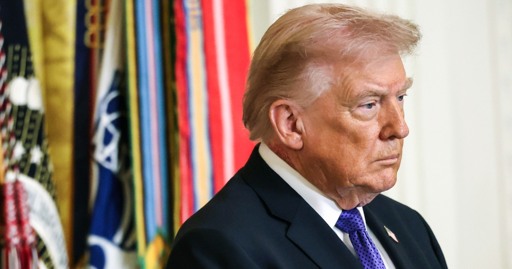
Trump won the presidency in 2016 and 2024 thanks in no small part to campaigning against the long and draining wars of his predecessors. Now, he’s started a war of his own.

  • givesomefucks@lemmy.world
    link
    fedilink
    English
    arrow-up
    1
    arrow-down
    1
    ·
    8 hours ago

    In any First Past the Post election, you have the Spoiler Effect,

    No, that’s only after two parties have normalized and aren’t running primaries representative of their voters desires in a candidate…

    It doesn’t matter what someone said 250 years ago.

    Like, what kind of ancestor worship does it take to think that could have been the end all discussion, and what kind of nativity does to think to not realize society has changed drastically since?

    People didn’t stop discussing this, and shit didn’t stop changing.

    Stop ready classical literature and at least get to the 20th century if not the 21st.

    • chaogomu@lemmy.world
      link
      fedilink
      English
      arrow-up
      2
      ·
      8 hours ago

      Oh, you want 20th century again? You didn’t like it in my original comment, but back to Arrow’s Impossibility Theorem, proven definitively in 1950.

      Arrow’s impossibility theorem is a key result in social choice theory showing that no ranked-choice procedure for group decision-making can satisfy the requirements of rational choice.[1] Specifically, American economist Kenneth Arrow showed no such rule can satisfy independence of irrelevant alternatives, the principle that a choice between two alternatives A and B should not depend on the quality of some third, unrelated option, C.[2][3][4]

      The result is often cited in discussions of voting rules,[5] where it shows no ranked voting rule can eliminate the spoiler effect.[6][7][8] This result was first shown by the Marquis de Condorcet, whose voting paradox showed the impossibility of logically-consistent majority rule; Arrow’s theorem generalizes Condorcet’s findings to include non-majoritarian rules like collective leadership or consensus decision-making.[1]

      Then a bit later, this important part;

      Rated voting rules, where voters assign a separate grade to each candidate, are not affected by Arrow’s theorem.[17][18][19] Arrow initially asserted the information provided by these systems was meaningless and therefore could not be used to prevent paradoxes, leading him to overlook them.[20] However, Arrow would later describe this as a mistake,[21][22] admitting rules based on cardinal utilities (such as score and approval voting) are not subject to his theorem.[23][24]

      The Spoiler Effect is when a voting system fails independence of irrelevant alternatives. This is what drives two party dominance, after all, if you’re punished for voting third party, third parties become actively harmful. This is why the major support for most third parties comes from their ideological opponents. Jill Stein being super cozy with Russia and Republican donors being the key recent example.