

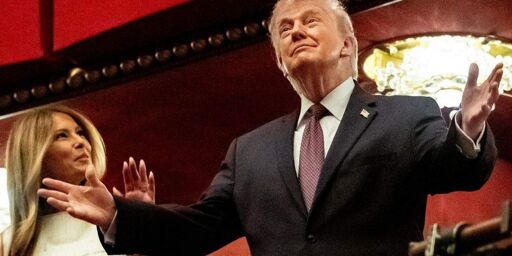
A gay journalist says he was briefly detained by security after he booed President Donald Trump during the opening night of the musical Chicago at the Kennedy Center in Washington, D.C.
A gay journalist says he was briefly detained by security after he booed President Donald Trump during the opening night of the musical Chicago at the Kennedy Center in Washington, D.C.
I’m confused what “detained” means in this context. The article Advocate is reporting on is from the Washington Blade, and it says Ramirez booed once Trump showed up in the balcony box, was “briefly detained by security” until the lights dimmed and the play started, and Ramirez watched the play. Does it mean that Ramirez was given the option by security to either leave or sit outside the theater until the play actually started?
Of note is that Ramirez is a journalist, but he wasn’t acting as one when this happened. Maybe other people get different vibes, but I feel like the title implies that – since a journalist being detained usually conjures imagery of arresting someone actively reporting something for a news outlet to silence them.
He addresses that directly FWIW
I did read the whole article, and I don’t feel like that excerpt addresses it at all. He says “being questioned about speech”, but what that questioning entailed or whether he was allowed to leave (in which case, that’s not actually detainment) is never addressed.
(Aside to the detainment question: e.g. libraries are government-funded; I can still be kicked out of them if I start yelling in one. The Kennedy Center is a public–private partnership, and this was private security, but it’s not like rules still don’t apply if I walked into a fully federally owned government building. I think his argument that his being kicked out of the theater temporarily for loudly booing before the show “undermines the First Amendment” because the Center receives federal funding is nonsense, even though I wholeheartedly support his booing. He notes that there was positive disruption like clapping from others, but it doesn’t “undermine the First Amendment” that he was singled out to temporarily leave.)
It doesn’t matter, he was prevented by officials from expressing his opinion. That means his freedom of speech was oppressed.
“His freedom of speech was oppressed” in functionally the same sense that it is if I get banned from a social media platform or kicked out of a library for making a disturbance. It’s not even remotely a First Amendment issue, and him citing the 1A is bonkers.
I think in another life you’d be supporting those obnoxious, far-right “First Amendment auditors” who walk into e.g. a library or USPS building, start making a scene, and think that being kicked out means their constitutional rights have been impinged. Not because you have ill intent but because you fundamentally do not understand what the 1A does or is supposed to do.
it really depends on the context in which he was booing. Reading the article, in this context he did nothing wrong. If you can cheer, you can boo. He was not causing a disturbance.
Sure, and that’s a fine opinion to have. I disagree they need to be treated the same way, yet I support his booing regardless of the consequences, and if it were up to me, Trump would be barred from the venue anyway and no booing would happen (not that he functionally could be right now as chairman).
It doesn’t make what happened to him even remotely a constitutional issue. This isn’t even a little ambiguous; you’d just have to entirely not understand or willfully, grossly misinterpret the 1A to drag it into this.