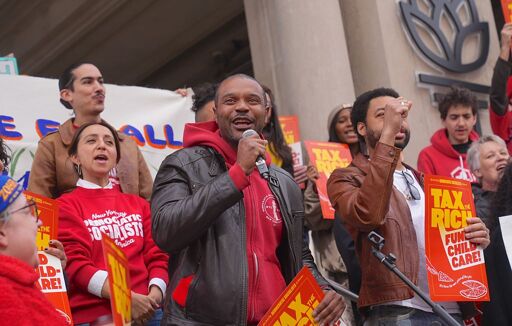
Could democratic socialism become the brand of a new generation of political actors — not just on the fringe, not just in New York City, but across the country?
Social democracy and democratic socialism are not the same.
Social democracy, yes, is what you describe: try to regulate capitalism and make it livable via labor protections, public services and a welfare state. The end horizon is something like the Scandinavian dream.
Democratic socialism is different: the end horizon is indeed full blown socialism, with social ownership of the means of production and ultimately with abolition of capitalist relations altogether. However, for democratic socialists, the path to that horizon does not pass via revolution but via the democratic process.
In practice social-democrats and democratic-socialists end up finding it easy to agree on a political program for the here and now and so very often they coexist. Both want to reform capitalism.They just don’t agree as to how deep that reform can go. For the democratic socialists, the things social-democrats want are in fact the means towards the end result. For the social-democrats that end result is not necessary considered possible or even desirable. But the two have never won that much that their differences would actually come to a head.
I’d be surprised that anyone would want to stop at the SocDem phase of things. Like if you actually get that far and things are going well, wouldn’t you want to take that next step? I guess it depends on perceived risk?
Nobody has ever reached a point where that was actually a practical decision to make. So nobody has ever said oh yea this is enough we should stop :)
Edouard Bernstein, the first theoretical of social democracy famously said that the “the final goal of socialism is nothing, the movement is everything”. I think it’s a matter of perspective, of what you choose to care about. My most sympathetic read of this position is that actually abandoning capitalist relations is not something that you can “choose” to realistically do because capitalism is too tied up with the survival needs of people.
While I agree that the end goal of democratic socialism is an economy in which the means of production are publicly owned, it differs significantly from the Marxist-Leninist model advocated by Lenin and later implemented by Stalin. Democratic socialism rejects the one-party state and instead maintains that democratic institutions, competitive elections, and civil liberties should continue to exist even after the economy is fully socialized.
That’s a massive distinction, especially considering that every major one-party socialist state has produced severe authoritarian outcomes.
China is a notable exception in one respect: while it remains governed by a single-party communist state, its economy has embraced extensive market mechanisms, private enterprise, and foreign investment. Whether it should still be described as socialist depends largely on which definition of socialism is being used.
Yes it is very different from Leninism. But what you’re describing are still “how” elements not “what”. And to call a spade a spade, Democratic socialism and social democracy are both deeply rooted in the Marxist tradition. The former in the thought of Karl Kautsky, the latter in the thought of Eduard Bernstein.
Bernstein is exactly who Rosa Luxemburg is responding to in “Social Reform or Revolution?”.
Kautsky positioned himself in the centre between Bernstein’s revisionist reformism and what he saw as Luxembourg’s adventurism. He was in fact a huge influence on Lenin himself, who considered Kautsky a real authority in Marxism but disagreed on his tactical analysis and ultimately he ended up rejecting it.
Long story short, democratic socialism is not external to the body of Marxist thought. It played a key role in its intellectual development. For Leninists it became the anvil on which they hammered their own understanding. But since the fall of the Soviet experiment and the dengist/nationalist turn of the Chinese one, taking a serious second look at democratic socialism is, I think, the intellectually robust thing to do.
Well, when it comes to practice there are a few things:
People should not be scared to call themselves socialists and still lay claim to liberal democratic bona fides. That combination is not a ruse and a fraud as the Right would like to insist but a real current in socialist thought since the beginning. The newly elected leader of the NDP here in Canada actually came out and called it recently.
I would actually also argue that honest social democrats, can in practice be more radical than self proclaimed socialists, if in practical politics they propose and achieve deeper reforms. I’ll trade an effective Mamdani for a high falutin big mouth talking European self proclaimed socialist that does fuck all (looking at Tsipras) any day of the week. It’s easy to talk a big game and do nothing and we shouldn’t underestimate the transformative power of promising modest reform and delivering.
It’s also important to keep reminding so called moderates eg in the Democratic Party that DSs and SDs can very much coexist in a left of centre party and that cosplaying the red scare all the time is extremely self defeating. Common ground exists.
Finally, I would say it is also important to not cede the socialist vision to the MLs as if they are the sole and rightful owners of it. They are not, never have been, and liberal democracy is not as alien a concept to socialist thought as they pretend it to be. Political liberalism is not only reconcilable with socialism but there are very legitimate currents of Marxist thought that assert it. Nicos Poulantzas famously argued that “socialism will be democratic or it will not be at all”, asserting that institutions of representative democracy are essential for a socialist transition to avoid authoritarian state-socialism.
Given that, so far, precisely none of the Marxist-Leninist states have successfully transitioned into a classless system (or even tried to), I’d say that the last bullet point is especially relevant.
It’s awfully tempting to retain that total power over others, once given it. There’s only been a handful of people throughout history that have willingly handed the reins of power back after the crisis was resolved.
There isn’t a “real” socialist or a “fake” socialist. Socialism has a definition: public ownership of the means of production. That’s the defining characteristic. Everything else, whether it’s democratic socialism, Marxism-Leninism, libertarian socialism, or anything else, is a modifier that describes how someone thinks that goal should be achieved or what political system should accompany it.
My point wasn’t about which branch of socialism is better or more democratic. It was that people routinely use the terms socialist, social democrat, and democratic socialist interchangeably when they are not the same thing.
So how does your comment address that? My original point was about people misusing basic political terminology, not about whether one type of socialist is preferable to another.
There’s also a recurring pattern on this platform where people simply don’t know what these terms mean. “Socialism,” “social democracy,” “democratic socialism,” and even “capitalism” all get thrown around as interchangeable labels, when they describe different concepts. That’s the misconception I’m pushing back against, and it’s one I run into constantly. You and I seem to be the exception here, we at least understand the terminology well enough to have a discussion about the ideas instead of arguing over incorrect definitions.


Social democracy and democratic socialism are not the same.
Social democracy, yes, is what you describe: try to regulate capitalism and make it livable via labor protections, public services and a welfare state. The end horizon is something like the Scandinavian dream.
Democratic socialism is different: the end horizon is indeed full blown socialism, with social ownership of the means of production and ultimately with abolition of capitalist relations altogether. However, for democratic socialists, the path to that horizon does not pass via revolution but via the democratic process.
In practice social-democrats and democratic-socialists end up finding it easy to agree on a political program for the here and now and so very often they coexist. Both want to reform capitalism.They just don’t agree as to how deep that reform can go. For the democratic socialists, the things social-democrats want are in fact the means towards the end result. For the social-democrats that end result is not necessary considered possible or even desirable. But the two have never won that much that their differences would actually come to a head.
I’d be surprised that anyone would want to stop at the SocDem phase of things. Like if you actually get that far and things are going well, wouldn’t you want to take that next step? I guess it depends on perceived risk?
Nobody has ever reached a point where that was actually a practical decision to make. So nobody has ever said oh yea this is enough we should stop :)
Edouard Bernstein, the first theoretical of social democracy famously said that the “the final goal of socialism is nothing, the movement is everything”. I think it’s a matter of perspective, of what you choose to care about. My most sympathetic read of this position is that actually abandoning capitalist relations is not something that you can “choose” to realistically do because capitalism is too tied up with the survival needs of people.
While I agree that the end goal of democratic socialism is an economy in which the means of production are publicly owned, it differs significantly from the Marxist-Leninist model advocated by Lenin and later implemented by Stalin. Democratic socialism rejects the one-party state and instead maintains that democratic institutions, competitive elections, and civil liberties should continue to exist even after the economy is fully socialized.
That’s a massive distinction, especially considering that every major one-party socialist state has produced severe authoritarian outcomes.
China is a notable exception in one respect: while it remains governed by a single-party communist state, its economy has embraced extensive market mechanisms, private enterprise, and foreign investment. Whether it should still be described as socialist depends largely on which definition of socialism is being used.
Yes it is very different from Leninism. But what you’re describing are still “how” elements not “what”. And to call a spade a spade, Democratic socialism and social democracy are both deeply rooted in the Marxist tradition. The former in the thought of Karl Kautsky, the latter in the thought of Eduard Bernstein.
Bernstein is exactly who Rosa Luxemburg is responding to in “Social Reform or Revolution?”. Kautsky positioned himself in the centre between Bernstein’s revisionist reformism and what he saw as Luxembourg’s adventurism. He was in fact a huge influence on Lenin himself, who considered Kautsky a real authority in Marxism but disagreed on his tactical analysis and ultimately he ended up rejecting it.
Long story short, democratic socialism is not external to the body of Marxist thought. It played a key role in its intellectual development. For Leninists it became the anvil on which they hammered their own understanding. But since the fall of the Soviet experiment and the dengist/nationalist turn of the Chinese one, taking a serious second look at democratic socialism is, I think, the intellectually robust thing to do.
That’s a lot of a lot dude. And you’re basically right.
So what does this have to do with people not understanding and misusing the term socialism versus social democracy and Democratic socialism?
And I see that you obviously don’t fall into that camp. You know what you’re talking about.
Well, when it comes to practice there are a few things:
People should not be scared to call themselves socialists and still lay claim to liberal democratic bona fides. That combination is not a ruse and a fraud as the Right would like to insist but a real current in socialist thought since the beginning. The newly elected leader of the NDP here in Canada actually came out and called it recently.
I would actually also argue that honest social democrats, can in practice be more radical than self proclaimed socialists, if in practical politics they propose and achieve deeper reforms. I’ll trade an effective Mamdani for a high falutin big mouth talking European self proclaimed socialist that does fuck all (looking at Tsipras) any day of the week. It’s easy to talk a big game and do nothing and we shouldn’t underestimate the transformative power of promising modest reform and delivering.
It’s also important to keep reminding so called moderates eg in the Democratic Party that DSs and SDs can very much coexist in a left of centre party and that cosplaying the red scare all the time is extremely self defeating. Common ground exists.
Finally, I would say it is also important to not cede the socialist vision to the MLs as if they are the sole and rightful owners of it. They are not, never have been, and liberal democracy is not as alien a concept to socialist thought as they pretend it to be. Political liberalism is not only reconcilable with socialism but there are very legitimate currents of Marxist thought that assert it. Nicos Poulantzas famously argued that “socialism will be democratic or it will not be at all”, asserting that institutions of representative democracy are essential for a socialist transition to avoid authoritarian state-socialism.
Given that, so far, precisely none of the Marxist-Leninist states have successfully transitioned into a classless system (or even tried to), I’d say that the last bullet point is especially relevant.
It’s awfully tempting to retain that total power over others, once given it. There’s only been a handful of people throughout history that have willingly handed the reins of power back after the crisis was resolved.
I think you’re missing the point I was making.
There isn’t a “real” socialist or a “fake” socialist. Socialism has a definition: public ownership of the means of production. That’s the defining characteristic. Everything else, whether it’s democratic socialism, Marxism-Leninism, libertarian socialism, or anything else, is a modifier that describes how someone thinks that goal should be achieved or what political system should accompany it.
My point wasn’t about which branch of socialism is better or more democratic. It was that people routinely use the terms socialist, social democrat, and democratic socialist interchangeably when they are not the same thing.
So how does your comment address that? My original point was about people misusing basic political terminology, not about whether one type of socialist is preferable to another.
There’s also a recurring pattern on this platform where people simply don’t know what these terms mean. “Socialism,” “social democracy,” “democratic socialism,” and even “capitalism” all get thrown around as interchangeable labels, when they describe different concepts. That’s the misconception I’m pushing back against, and it’s one I run into constantly. You and I seem to be the exception here, we at least understand the terminology well enough to have a discussion about the ideas instead of arguing over incorrect definitions.
I guess I’m helping by articulating my understanding?
Otherwise, yes we seem to not be disagreeing.