

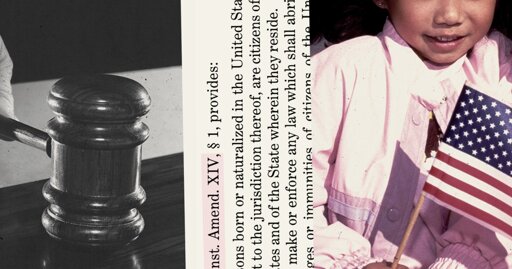
Experts on Native American law say the Elk v. Wilkins ruling has no bearing on whether the children of immigrants without permanent legal status can be denied birthright citizenship.
In a moment that could take on new significance almost 150 years later, Omaha election official Charles Wilkins on April 5, 1880, refused to register John Elk to vote on the grounds that he was Native American, and therefore not an American citizen.
The Supreme Court, in an 1884 case called Elk v. Wilkins, ruled against him, saying that Native Americans born within the territory of the United States did not have birthright citizenship. They had the same status as “the children of subjects of any foreign government born within the domain of that government,” the court said.
Donald Trump’s administration is now citing that case as it defends his plan to end automatic birthright citizenship, putting a new spin on the long-standing interpretation of the Constitution’s 14th Amendment. The Supreme Court hears oral arguments in the case on Wednesday.
I did as well.
Re: your username: after SDG&E decided that our palm was too close to the electric wires and needed to be removed, I have to disagree. That wood is horrible to try to work with. The tree ate two chainsaws.
Everyone on here gets pissed about my username. I just like the way they look and they can survive hurricanes while other bitch trees can’t. Technically it’s not even a tree but a giant grass which I think is super cool.
Fair enough. My favorite tree falls over in a stiff breeze so yeah, I can see why you like them. (Redwood/Giant Sequoias)
I’ve only seen smaller ones at a city park near me but one day I’ll go to their native range and see the big ones.
Technically that is basically what all trees are.
Trees are the crabs of the vegetable world.