
cross-posted from: https://lemmygrad.ml/post/12479555
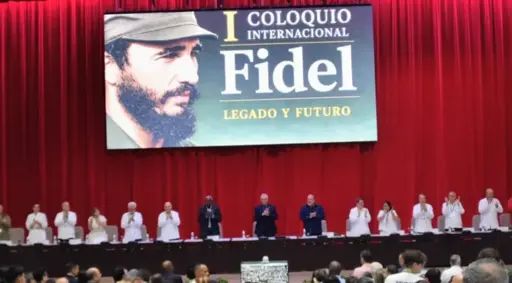
Some 1,500 delegates from 63 countries inaugurated this Monday at the Havana Convention Center the First International Colloquium “Fidel: Legacy and Future”, focused on remembering the life, work and thought of the historical leader of the Cuban Revolution, Fidel Castro (1926-2016).
The meeting, held before the start of the Havana International Book Fair, brought together representatives from Russia, China, Africa and Europe to express their support for the Caribbean island in the face of external aggression.
During the opening day, Mikhail Shvidkoi , the Russian president’s special envoy for cultural cooperation and head of his country’s delegation at the literary event, conveyed a message from President Vladimir Putin in which he emphasized that in Russia the memory of Fidel Castro is “venerated with deep respect” for being “a loyal and reliable friend of our country, who made a colossal personal contribution to building the multifaceted alliance between Havana and Moscow.”
Shvidkoi stated that the life of the “great revolutionary” and statesman was dedicated to serving the Fatherland, becoming "a symbol of freedom, justice and patriotism for Cubans and for millions of people around the world . "
The Russian representative argued that Castro’s name is “inextricably linked” to the modern history of Cuba , a period in which, under his leadership, socio-economic progress was made and Havana’s international prestige grew exponentially, while he worked to build a “just and truly democratic world order.”
Recalling his first trip to Cuba in January 1980, Shvidkoi reminisced about the day they bid farewell to Celia Sánchez, whom he described as “a great daughter of the Cuban people, a great revolutionary who was Fidel’s comrade-in-arms .” Regarding that occasion, he said, “That was the first time I heard Fidel speak. It was incredibly moving.”
He added that after the triumph of the Cuban Revolution in 1959, the Soviet Union embraced it as an “absolutely organic phenomenon of paramount importance for all the peoples of the world ,” understanding that it was “driven by the yearning for justice.” The Russian politician conveyed his country’s “unwavering solidarity” and Putin’s wishes for “good health, prosperity, and courage” for Cuban leader Raúl Castro, Fidel’s brother.
On behalf of the People’s Republic of China, Liu Haixing, a member of the Central Committee of the Communist Party of China (CPC) and head of its International Department, read a letter sent by General Secretary Xi Jinping to leader Raúl Castro and President Miguel Díaz-Canel. In the letter, Xi asserted that Fidel Castro achieved “immortal historical feats” dedicated to national liberation, the defense of sovereignty, and the building of socialism.
The Chinese president emphasized in the text that Fidel Castro cemented bilateral relations, allowing Cuba to be the first Latin American country to establish diplomatic ties with China, building over 66 years a benchmark of cooperation between socialist countries and of “sincere mutual assistance among nations of the Global South.” Xi reaffirmed China’s support for Cuba’s pursuit of a development model adapted to its national conditions, the defense of its security, and its opposition to foreign interference.
Liu Haixing evoked the bonds of friendship that united Fidel Castro with Mao Zedong and later with Xi Jinping, and warned that in the face of a global scenario marked by “hegemonism, unilateralism and conflicts” , the Global Development, Global Security, Civilization and Global Governance initiatives promoted by Beijing are setting the course towards a community of shared future.
“The more complex and ever-changing this world becomes, the more crucial it is to strengthen conviction and solidarity ,” Liu emphasized, reaffirming the Chinese Communist Party’s commitment to the international system centered on the United Nations and multilateralism. Liu concluded with the proclamation: “The spirit of Fidel Castro is eternal, and long live the friendship between China and Cuba!”
Namibian Prime Minister Tjitunga Elijah Ngurare described Cuba as a “beacon of global solidarity and dignity” and conveyed a message of “peace and love” from President Netumbo Nandi-Ndaitwah. Ngurare stated that “one cannot speak of freedom in Southern Africa without acknowledging Cuba’s role ,” recalling that Cuban combatants fought alongside the Namibian and Angolan peoples until they defeated the Apartheid regime and achieved independence.
The head of government urged the international community to have the “moral courage” to support the island in the face of the US blockade and promised that Namibia “will never abandon” the Caribbean nation. He described Fidel Castro as a “transcendent figure who shaped the world we know today” and whose leadership transformed the island’s economic and social reality to unimaginable levels.
The president of the Party of the European Left (PEL), Austrian Walter Baier, asserted that the Cuban revolutionary victories demonstrated that “dignity can triumph over oppression .” Baier denounced the fact that the island has endured more than six decades of US blockade, the current energy embargo, and constant extraterritorial sanctions that constitute “collective punishment and silent genocide.”
He emphasized that “the people of the island have never surrendered, because dignity cannot be suppressed,” and noted that Fidel Castro demonstrated that people can change the course of history and the destiny of their nations. Baier warned that the colloquium is taking place at a “dangerous moment internationally,” positioning the defense of Cuba as the cause of all those who defend national sovereignty and the premise that “peace is stronger than war.”